

 中 文
中 文
What Are the Common Reasons for Rework in Denture Processing?
2024-11-20
2026-09-23
Zirconia has become a widely used material for CAD/CAM dental restorations because of its strength, chemical stability, and ability to achieve different levels of translucency and color. However, when working with pre-sintered white zirconia, achieving the desired shade usually requires a controlled coloring or staining process before sintering.
The staining liquid does not simply add color to the surface. Its interaction with the porous pre-sintered zirconia, together with the material's composition, application method, drying process, and sintering conditions, can all influence the final appearance of a zirconia crown.
Understanding these factors is important for achieving consistent and predictable color results.
Pre-sintered zirconia is typically much more porous and easier to process than fully sintered zirconia. This structure allows coloring components in a staining liquid to penetrate into the material before the final sintering process.
During sintering, the zirconia undergoes densification and shrinkage, while the coloring components remain incorporated within the material. As a result, the final color of the restoration is determined by more than the appearance of the zirconia immediately after staining.
This is why a zirconia crown may look different before and after sintering.
For white zirconia, staining can be used to:
The staining process therefore needs to be considered as part of the complete zirconia workflow rather than as an isolated surface treatment.
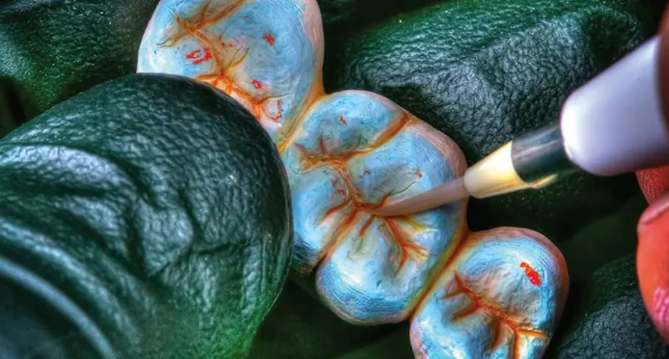
The coloring process begins when the staining liquid contacts the surface of the pre-sintered zirconia.
Because the material has an interconnected porous structure before sintering, the liquid can penetrate into the outer region of the restoration. The amount and distribution of the coloring components influence how the material appears after sintering.
Several factors can affect this process.
The concentration of coloring components has a direct influence on color intensity.
A higher concentration may produce a stronger shade, while a lower concentration generally results in a lighter effect. However, increasing the concentration does not necessarily produce a more natural result.
Excessive coloring can make the restoration appear too dark or overly saturated, while insufficient coloring may result in a shade that is too light.
Therefore, the target shade should be achieved through a controlled staining protocol rather than simply increasing the amount of coloring liquid.
The amount of staining liquid applied to the restoration can influence the uniformity of the final color.
If different areas receive significantly different amounts of liquid, the resulting crown may show visible shade variations after sintering.
This is particularly important for anatomically complex restorations. Grooves, margins, cervical areas, and other regions with different surface geometries may absorb the liquid differently.
Consistent application helps reduce unwanted differences between different areas of the same crown.
The penetration behavior of the staining liquid depends partly on the structure of the zirconia.
Different zirconia materials can have differences in:
These differences can affect how quickly and how deeply the coloring components move into the material.
As a result, the same staining procedure may not produce exactly the same color response on every type of zirconia.
This is one reason why staining protocols should be developed according to the specific zirconia material being used.
Using the same staining liquid does not guarantee an identical result.
The final color is influenced by the interaction between the staining liquid and the zirconia itself.
The composition of zirconia can influence its optical properties and response to coloring.
Different formulations may have different levels of translucency, opacity, and color response. These characteristics can affect how the staining liquid modifies the appearance of the final restoration.
Therefore, a staining protocol developed for one zirconia material should not automatically be transferred to another material without verification.
The starting color also matters.
White zirconia provides a relatively neutral base for staining, while pre-shaded zirconia already contains intrinsic coloring. Applying additional staining to pre-colored zirconia can therefore produce a different result from staining white zirconia.
The initial shade should always be considered when determining the staining procedure.
Restoration thickness can influence the perceived color.
A thicker zirconia restoration may appear different from a thinner one because the amount of material through which light passes changes the overall optical effect.
Translucency also interacts with thickness. Therefore, achieving a specific shade is not simply a matter of matching the staining liquid to a shade tab.
The material, restoration geometry, and thickness should be considered together.
Drying is an often-overlooked part of the staining process.
After staining, residual liquid needs to be removed appropriately before sintering. If different areas retain different amounts of moisture or solvent, the distribution of coloring components may become less uniform.
Uneven drying can potentially contribute to:
A standardized drying procedure can therefore help improve repeatability.
The exact drying conditions should follow the recommendations established for the specific zirconia and staining system being used.
The color observed after staining is not necessarily the final color of the crown.
Sintering causes significant changes in the physical structure of pre-sintered zirconia. The material becomes denser and undergoes dimensional shrinkage, while its optical properties also change.
The final appearance can therefore be affected by the sintering process, including:
If the recommended sintering conditions are not followed, the final color may differ from the expected result.
For this reason, staining and sintering should be treated as two connected stages of the same coloring workflow.
Several problems can occur when the staining process is not sufficiently controlled.
A crown may appear darker than the target shade when excessive coloring liquid, high concentration, or repeated application is used.
Insufficient staining or inadequate penetration may result in a shade that does not reach the desired intensity.
Uneven application, inconsistent liquid penetration, or insufficient drying may cause visible differences across the restoration.
Because the cervical region is often intentionally designed with greater color saturation, excessive staining in this area can make the transition appear unnatural.
Even when the same staining procedure is followed, differences in zirconia material, processing conditions, or furnace performance can influence the final result.
Documenting the staining and sintering parameters can help laboratories identify the source of variation.
Achieving consistent zirconia color requires control over the entire workflow rather than relying on the staining liquid alone.
Keep the application method, amount, and processing time as consistent as possible.
Different zirconia materials may have different coloring responses. The staining procedure should therefore be validated for the specific material being used.
Allow the restoration to dry under consistent conditions before sintering. Avoid comparing restorations processed with significantly different drying procedures.
Use the appropriate sintering parameters for the zirconia material. Changes in temperature or heating and cooling conditions can affect the final appearance.
Shade evaluation should take the final restoration thickness and translucency into account. A staining protocol that works for one restoration geometry may not produce the same visual effect on another.
For laboratories producing multiple restorations, recording staining concentration, application method, drying conditions, and sintering parameters can make it easier to reproduce successful results.
The final color of a zirconia crown is the result of several interacting factors.
A simplified way to understand the process is:
Final Color = Zirconia Material + Initial Shade + Staining + Drying + Sintering + Restoration Geometry
The staining liquid plays an important role, but it does not work independently.
The zirconia's composition and optical properties determine the starting point. The staining process modifies the color, while drying and sintering affect how consistently that color develops. Finally, restoration thickness and shape influence how the finished crown is perceived under light.
This explains why simply changing the staining liquid or increasing its concentration cannot always solve a shade-matching problem.
The effect of a zirconia staining liquid on the final color of a crown depends on much more than the coloring liquid itself.
Its concentration, application amount, penetration behavior, drying conditions, and interaction with the zirconia material can all influence the final shade. At the same time, restoration thickness, initial zirconia color, and sintering conditions can further affect the optical result.
For predictable zirconia coloring, the most important approach is to establish a standardized workflow and maintain consistent processing conditions.
By treating staining, drying, and sintering as interconnected stages, dental laboratories can better understand variations in zirconia color and improve the repeatability of their final restorations.

Dry & wet milling for zirconia, PMMA, wax with auto tool changer.
learn more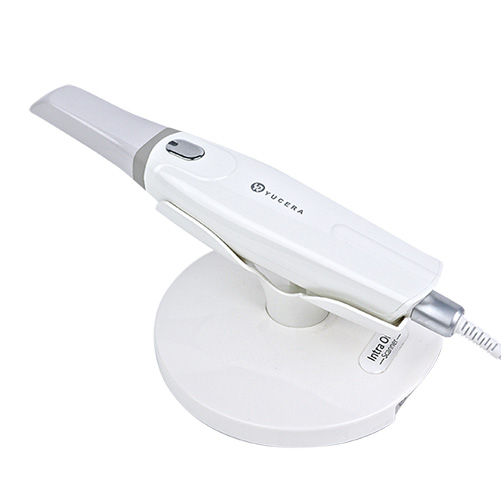
High-precision 3D scanning, AI calibration, full-arch accuracy.
learn more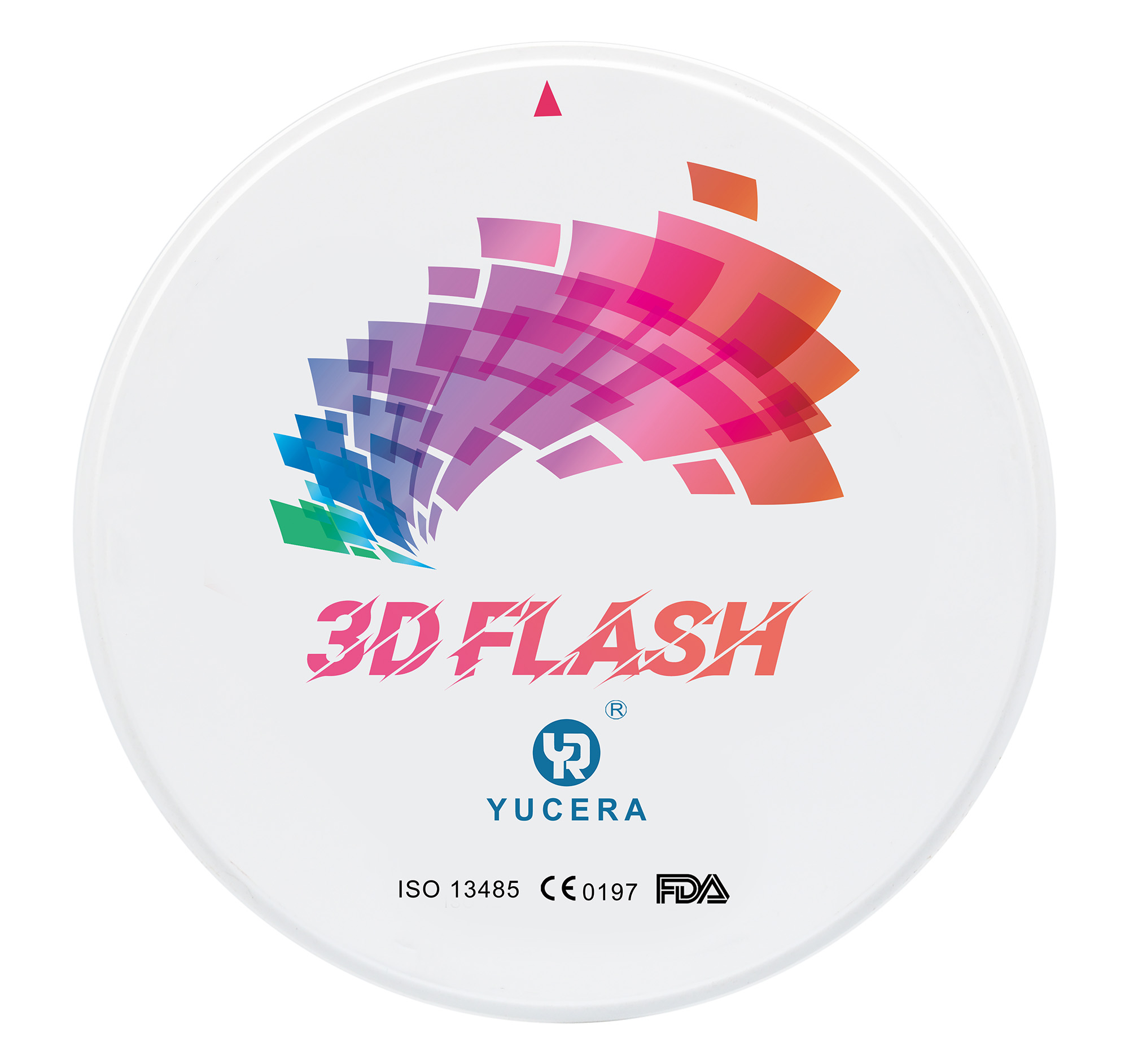
40-min full sintering with 57% incisal translucency and 1050 MPa strength.
learn more
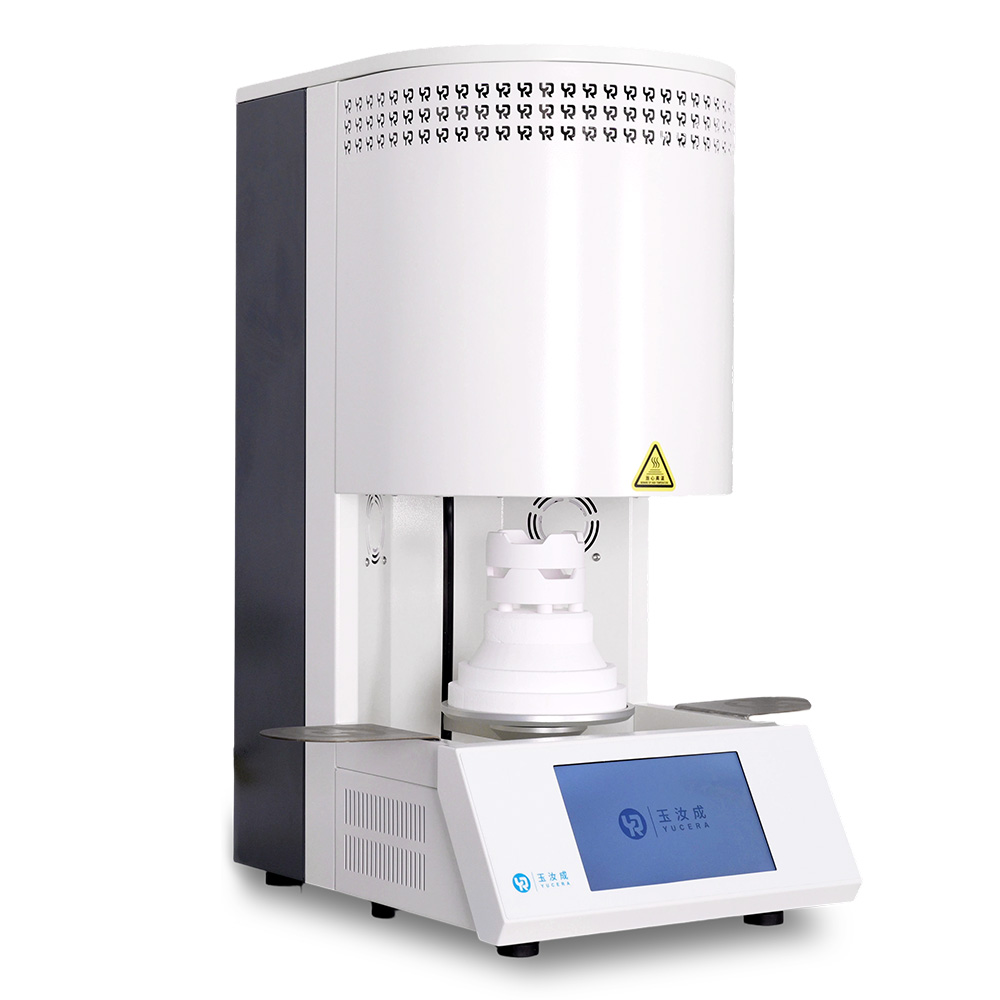
40-min cycle for 60 crowns, dual-layer crucible and 200°C/min heating.
learn more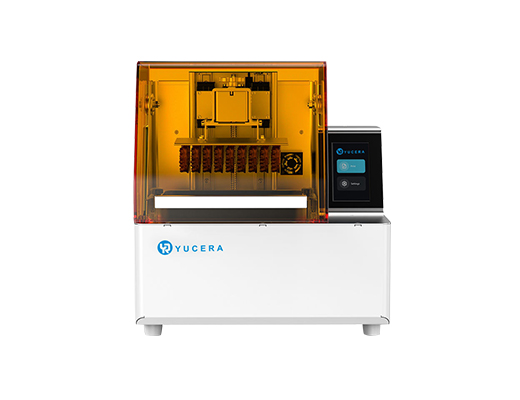
High-speed LCD printer for guides, temporaries, models with 8K resolution.
learn more